


Learn Stock Trading - Finrise
4.643.00 Reviews
App Specs
- Version
- 1.1.0
- Updated On
- License
- Free
- Downloads
- 50,000+
- Developer
- Deep Flow Apps
- Categories
- Education
- Platform
- Android
Screenshots

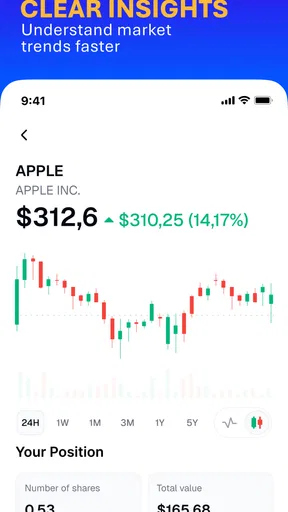
 Analysis by AppCompare
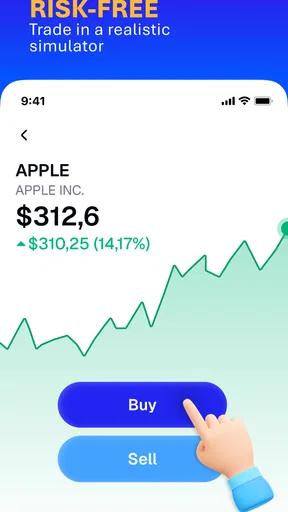
I approached Learn Stock Trading - Finrise as a learning tool rather than a shortcut to real investing. That distinction matters. This free education app from Deep Flow Apps is built around realistic market simulation, so its main value is giving beginners a place to practise decisions before putting actual money at risk. I found that focus more useful than a collection of disconnected definitions because it encourages you to think about timing, uncertainty, and consequences together.
The app has a 4.6 average from around 1.5 thousand ratings, with more than 50 thousand installs. Those figures suggest that Finrise has found a clear audience, but they do not replace personal judgment. The important question is whether simulated trading matches the way you learn best. If you want guided practice and a safer environment for testing your thinking, it is worth considering. If you mainly want live prices, professional analysis, or a direct route to buying shares, a different type of app will serve you better.
How I Decided Whether Finrise Was Worth Using
I focused on whether Finrise’s simulated practice could become a useful routine rather than a brief novelty. For me, that means asking what would make each return worthwhile: a clearer decision-making habit, a question to investigate, or a lesson I can carry into another learning tool. That standard leads naturally to the practical question of how its value holds up over time.
The first test: does it teach decisions, not just vocabulary?
Many beginner investing apps explain terms such as diversification, risk, and market orders, then leave the learner with little opportunity to apply them. Finrise is more interesting because its central idea is simulation. I could treat each choice as a small experiment: form a view, act on it, observe the result, and reconsider the reasoning. That loop is much closer to the mental work of investing than memorising a glossary.
I would judge an app like this by three questions. Can a new learner understand what to do without already knowing market language? Does the simulation encourage a repeatable process instead of impulsive guesses? And does it make mistakes feel informative rather than merely disappointing? Finrise is strongest when you use it deliberately, recording why you made a choice and reviewing the outcome later.
Why realistic simulation is useful for beginners
Real money adds emotional pressure that can overwhelm a new investor. A falling position may tempt someone to sell immediately, while a rising one can create false confidence. Simulation removes the financial damage while preserving the need to make a decision. That makes it a practical rehearsal space, especially for someone who understands basic concepts but has never had to choose between waiting, buying, or changing course.
There is an important limitation, though. A simulated result cannot reproduce every part of real ownership. It cannot fully recreate the anxiety of losing savings, the patience required over a long period, or the personal consequences of a poor decision. I would therefore treat Finrise as a training ground, not proof that I am ready to manage a portfolio.
Worth Reading Before You Choose

EA SPORTS FC Mobile 26 Is a Bigger Football Game, but It Takes Time

Flipboard Shows What News Apps Must Do Beyond the Feed

Switching to Android Auto Means Rethinking Your Driving Routine

Google Calendar Makes a Crowded Week Easier to Manage

Ludo King Makes the Most of the Minutes Between Plans

Baby Panda World Brings Quick Play to Modern Phones, but Its Game Library Feels Busy
My recommended learning routine
The most useful way to approach the app is to give every session a purpose. Before making a simulated trade, I would write down what I expect to happen and why. I would also note what could prove that expectation wrong. Afterward, I would review whether the outcome came from a sound process or simple luck. This small habit turns the app from an entertaining guessing exercise into a basic investing journal.
A second useful rule is to change only one idea at a time. If you alter the asset choice, timing, and strategy together, you will not know which decision helped or hurt. Keeping the experiment narrow makes the feedback easier to understand. This is one of the app’s less obvious strengths: it gives a beginner a setting in which disciplined repetition is possible without financial consequences.
Where the app fits in an everyday situation
Imagine someone who has started hearing coworkers discuss shares and feels pressure to join in. They have a spare half hour on a weekend, but they are not ready to open a brokerage account. Finrise can give that person a structured first step. They can practise reading a situation, choose an action, and see how their thinking holds up without confusing curiosity with financial readiness.
Another realistic use is preparation before a conversation with a financial professional. A learner who has spent time simulating decisions may arrive with clearer questions about risk, time horizon, and diversification. The app will not provide personal financial advice, but it can help someone become less intimidated by the subject.
Where Finrise wins against ordinary beginner resources
Compared with articles, videos, or a conventional investing glossary, Finrise offers a more active learning experience. Reading can make a concept feel familiar without proving that you can use it. Simulation exposes that gap quickly. I may understand the phrase “buy low” in theory, yet still struggle to decide what information should influence a purchase. Practising that judgment is more valuable than collecting another definition.
It also has an advantage over jumping directly into a live brokerage app. A brokerage account is designed for transactions, not necessarily for teaching a beginner how to think. Its interface can make buying feel easy before the user has developed a process. Finrise creates a buffer between interest and action, which is exactly where many new investors need more time.
The app’s real win is not prediction; it is consequence-free practice. That makes it especially suitable for people who learn by doing and who need to see how an idea behaves over a sequence of decisions.
What I would not expect it to replace
Finrise should not replace careful research, a diversified long-term plan, or professional guidance when someone’s circumstances are complicated. It is also not the right choice for a user who needs current market execution, account management, tax records, or a complete view of personal finances. Those needs belong to brokerage, portfolio-management, or financial-planning tools.
I would also be cautious about using a strong simulated result as a reason to trade aggressively. Success in a practice environment can encourage overconfidence, especially if the learner has not experienced a long period of uncertainty. The best outcome is not finishing with the belief that every market move can be anticipated. It is learning to define risk and accept that an attractive idea can still fail.
How it compares with other learning routes
There are three broad alternatives in this category. The first is passive education: books, articles, and video courses. These are often better when you want a thorough explanation of accounting, economics, or investing history. Their weakness is that they may leave you unprepared for the moment when several reasonable choices compete.
The second is a live investment platform. That is the better route when your priority is execution, but it carries a much higher cost for mistakes. It may also encourage a beginner to focus on the button that places an order rather than the reasoning behind the order. Finrise is more appropriate before that stage, although it cannot provide the practical functions of a live platform.
The third is a spreadsheet or paper portfolio. This alternative is flexible and excellent for learners who enjoy building their own framework. You can record assumptions, compare scenarios, and create a long-term record. The trade-off is effort: you must design the system yourself. Finrise is easier to start with, while a spreadsheet may become more powerful for someone who wants detailed control.
Small workflow choices that improve the experience
I would avoid treating every simulated position as a separate challenge. Instead, group decisions around a question, such as whether your reasoning changes when the market moves against you. This makes the practice more coherent and exposes emotional habits that a single isolated result can hide.
I would also separate “being right” from “having a good process.” A prediction can work for the wrong reason, and a careful decision can produce an unfavourable result. If you only reward yourself for winning outcomes, the app may teach confidence rather than judgment. Reviewing the original assumption is more useful than celebrating a lucky result.
Finally, I would set a stopping point for each session. Endless simulated activity can become a form of entertainment, especially when there is no real financial cost. A short session followed by written reflection is likely to teach more than repeatedly making trades without reviewing them.
Practical details before installing
Finrise is free to download, which lowers the barrier for someone who wants to test the learning approach before committing. It is marked for Everyone, making it broadly accessible from an age-rating perspective. The current version is 1.1.0 and it requires Android 7.0 or later, so compatibility should be straightforward for many Android users with older devices still in service.
The app includes in-app purchases ranging from $6.99 to $59.99 per item. That does not automatically make it poor value, but it does change how I would approach it. I would begin with the free experience and decide whether the learning workflow genuinely helps before paying for anything. A purchase is easier to justify when it supports a routine you already use, not when it is being made out of excitement after a single successful simulation.
Because the app’s purpose is education, I would also keep its role clear when discussing it with younger users. The Everyone rating means the content is broadly suitable, but learning about markets is still a subject that benefits from adult context. A young learner should understand that simulated gains are not guaranteed in real investing and that money decisions involve personal circumstances.
The cost of switching to a different tool
Moving from Finrise to another resource is not especially difficult if you have used it as a practice environment rather than as your only source of knowledge. The transferable benefit is the habit of stating an assumption, making a decision, and reviewing the result. That process works in a notebook, spreadsheet, course, or brokerage research screen.
The switching cost becomes higher if you expect the app to contain everything. A learner who has not kept notes may lose the reasoning behind earlier choices, making it harder to compare progress elsewhere. My advice is to maintain a simple external record from the first session. Write the date, the decision, the reason, the risk you accepted, and what you learned afterward. That record remains useful even if you later move to a more advanced platform.
There is also a mental switching cost. Simulation encourages experimentation, while real investing demands restraint and personal budgeting. Before moving from one to the other, I would create a separate checklist covering emergency savings, time horizon, acceptable loss, and the difference between money needed soon and money available for long-term goals. Finrise can help with market thinking, but it cannot make those personal decisions for you.
Who should choose Finrise?
I would recommend it to a complete beginner who wants to understand stock-trading decisions through practice. It is also a good fit for a cautious learner who is curious about markets but does not yet feel ready to risk money. Someone returning to investing after a long break may find the simulation useful for rebuilding confidence and identifying gaps in their knowledge.
It can also suit a learner who dislikes passive courses. If you remember ideas better after applying them, Finrise’s simulation-first approach is more engaging than reading explanations alone. Used alongside a notebook and reliable educational material, it can become a sensible first stage in a broader learning plan.
Who should skip it?
I would skip Finrise if your immediate goal is to buy and sell real securities, monitor an existing portfolio, or receive personalised financial advice. A live investing service or a qualified adviser is more appropriate for those tasks. I would also look elsewhere if you prefer deep written lessons, formal curriculum structure, or detailed financial modelling rather than practice through simulation.
It is not ideal for someone who tends to interpret every successful outcome as evidence of skill. The app can create a safe place to make mistakes, but the user still has to be honest about them. Without reflection, simulation may reinforce impulsive habits instead of correcting them.
My final recommendation
After using Finrise as a decision-training tool, I see its strongest purpose clearly: it helps turn vague interest in the stock market into a repeatable practice routine. The app is free to start, accessible on Android 7.0 and above, and focused on realistic simulation rather than simply presenting investing as a list of terms. That makes it a sensible first stop for a beginner who wants to learn by trying.
I would not use it as my only investing resource, and I would not treat simulated performance as a green light for real trading. Its lessons become much stronger when paired with written reflection, independent study, and a clear personal budget. The in-app purchase range also means I would test the free experience carefully before spending more.
My recommendation is straightforward: try Finrise if you need a low-risk way to practise market decisions, especially before opening a live account. Stay with it if the review-and-reflect workflow improves your thinking. Move to a different category of tool when you need live execution, personal planning, or deeper technical research. Use it to build judgment, not to chase the feeling of being right.
Pros
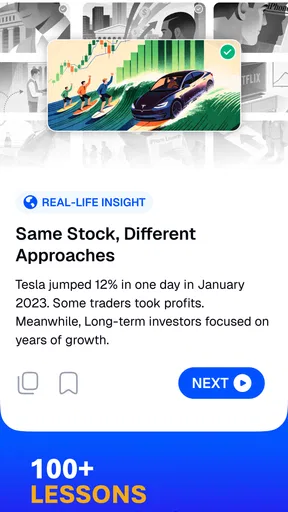
- Beginner-friendly lessons explain core stock market concepts clearly.
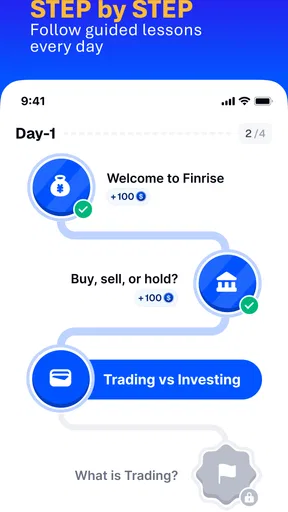
- Short learning modules make it easy to study during spare moments.
- Practical examples help connect trading theory with real decisions.
- Progress tracking can encourage consistent learning habits.
- Useful introduction for users with little or no investing experience.
Cons
- Content may feel too basic for experienced traders.
- Some features or lessons may require a paid subscription.
- It does not replace personalized financial advice or research.
- Market information may not always reflect the latest conditions.
- Learning alone does not guarantee profitable trading results.
FAQs for Learn Stock Trading - Finrise
What is Learn Stock Trading - Finrise?
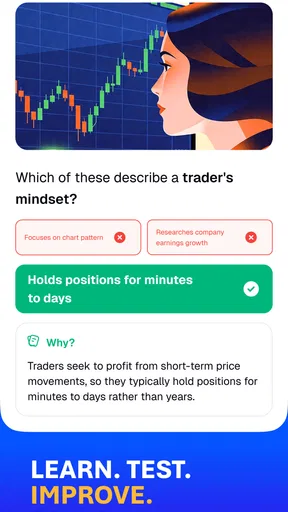
Learn Stock Trading - Finrise is an educational app designed to help beginners understand stock-market investing and trading. It typically presents lessons, explanations, market terminology, quizzes, and practical examples in a mobile-friendly format. The app is intended to make financial concepts easier to follow, but it should be treated as an educational resource rather than a personal investment adviser or a guarantee of trading success.
Is Learn Stock Trading - Finrise suitable for complete beginners?
Yes, the app is primarily aimed at users who are new to stocks and trading. Its structured learning approach can help explain topics such as shares, market orders, charts, risk management, and basic strategies without assuming extensive financial knowledge. Beginners should still study at their own pace and verify important information, because lessons may simplify complex subjects and cannot replace professional financial education.
Does Learn Stock Trading - Finrise let me buy or sell real stocks?
Learn Stock Trading - Finrise should not be confused with a full brokerage platform. Its main purpose is learning, so users should not expect the same account-opening, order-execution, custody, or withdrawal features offered by a regulated broker. Before attempting to trade with real money, you would need a separate brokerage account and should check that the provider is authorized in your country.
Is Learn Stock Trading - Finrise free to use?
The availability of free lessons and any premium material can depend on the current version of the app, your device, and the developer’s subscription model. Some educational sections may be accessible without payment, while advanced courses or additional features could require a purchase or recurring subscription. Review the app-store listing, pricing screen, renewal terms, and cancellation policy carefully before entering payment details.
Can Learn Stock Trading - Finrise guarantee profits or provide reliable stock picks?
No educational app can guarantee profits, remove market risk, or accurately predict every stock’s future performance. Learn Stock Trading - Finrise may explain strategies and investing concepts, but any examples, signals, or market commentary should be considered informational rather than guaranteed recommendations. Always research independently, consider your financial situation and risk tolerance, and never invest money you cannot afford to lose.


